What makes the greatest of all time, the greatest of all time? It’s more than just continued excellence (Thierry Henry) or two to three seasons at the very peak before becoming a mere excellent player (Ronaldinho). You do need one of those, but to be considered in the running for the very best, you need a moment or moments on the biggest stages — the World Cup final, the Champions League final, the Euros final, the Copa América and Libertadores finals. Basically a late-stage knockout of a major international or continental competition.
Take any one of the regularly wheeled out GOATs and they have that moment:
- Pelé with two goals in the World Cup final aged 17, scoring in a second final, and also scoring in both the 1962 and 1963 Copa Libertadores finals.
- Zidane with the two headers in the 1998 World Cup final, the Panenka in the 2006 World Cup final, and the left-foot volley in the 2002 Champions League final.
- Messi — goals in both the Champions League finals and the World Cup final.
- Cristiano Ronaldo — goals in three different Champions League finals (for two different teams, no less).
- Ronaldo Nazário — World Cup final, Copa América final (twice), UEFA Cup final, Cup Winners’ Cup final.
- Maradona — World Cup semi destruction of Belgium, a goal in the UEFA Cup final for Napoli, and creating Burruchaga’s winning goal in the 1986 World Cup final.
You get the idea. The elite have these big moments on top of excellent careers. And it’s this “Big Game Player” attribute that I’ve tried to measure.
So how do we do this?
Through an exercise started 15 years ago and taken up again recently, we’ve tracked every single goalscorer for every major international and continental final in the history of football. There’s over 4,000 goals, dating back to the first World Cup in 1930, all the way up to 2026. Multiple sources have been used — Wikipedia, Transfermarkt, RSSSF, ESPN, BBC, UEFA, FIFA, to name the main ones, but not all.
There were some gaps. The original plan was to capture semi-finals as well, and for the most part we have that, along with some odd final group-stage games that were either equivalent to semi-finals or, in the strange case of the 1950 World Cup, a final league game to decide the winner of the tournament.
But for some of the tournaments, such as the African Cup of Nations (and its iterations) and the African equivalent of the Champions League, there are some scorers missing. For the second-tier UEFA tournaments (UEFA Cup, Europa League, Cup Winners’ Cup, Conference League) plus the Copa Sudamericana, we’ve gone final only, intentionally.
“Where’s Trevor Brooking’s winner in the 1980 FA Cup?” I hear you ask. Well, it would be near impossible to include domestic cup finals for the history of football, so whilst they are undoubtedly big games, they don’t make the cut for this list.
Unfortunately, assists data is not readily available, nor are the line-ups (for tracking clean sheets) as reliable the further back we go. So for my attempt to track the best big-game players in history, I had to reluctantly limit it to goalscoring only. Goals are not the only key part of a big-game performance, but they are at least recorded.
The findings
You’re not here for tales about the admin side, you want results, god-damn-it. So without further ado I’ve pulled together some of the more interesting findings from close to 100 years of major games. You can then use the tool on the site to go explore — search by tournament, decade, stage, nationality, or the player you’re interested in, using Big Game Scorers.
Firstly, the all-timers. Either by number of goals or number of finals, these men stand out.
Scored in the final of the most competitions
Ronaldo Nazário — in history, he’s the only player to have scored in four different major tournament finals. On top of the 2002 World Cup final, pre-injury Ronaldo was well worth his nickname, the Phenomenon. Goals in two Copa América finals, and in the good old days when just the champions qualified for the Champions League, he had goals in both the Cup Winners’ Cup final for Barcelona and the UEFA Cup final against Lazio — with his most famous goal for Inter.
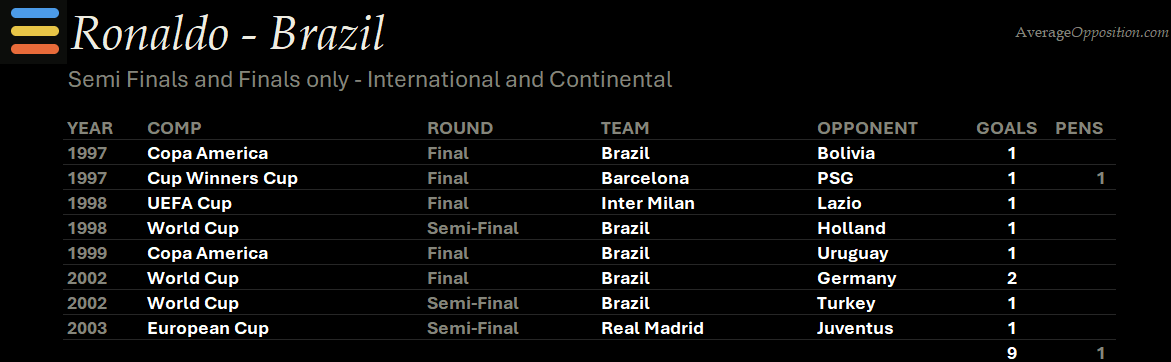
The Champions League is often raised as a stick to beat him with in the GOAT debate, but he only played in six Champions League games pre-injury, and as with every other tournament that he played in, he scored in the latest stage that he appeared — in this instance for Real Madrid in the semi-final against Juventus in 2003. If you wanted a big-game player as a sure bet, Ronaldo Nazário was the man.
Scorers in the final of three different competitions
After Ronaldo’s four above, there’s a select group of just four players that have scored in the final of three different competitions. Some in the GOAT debate, others a surprise.
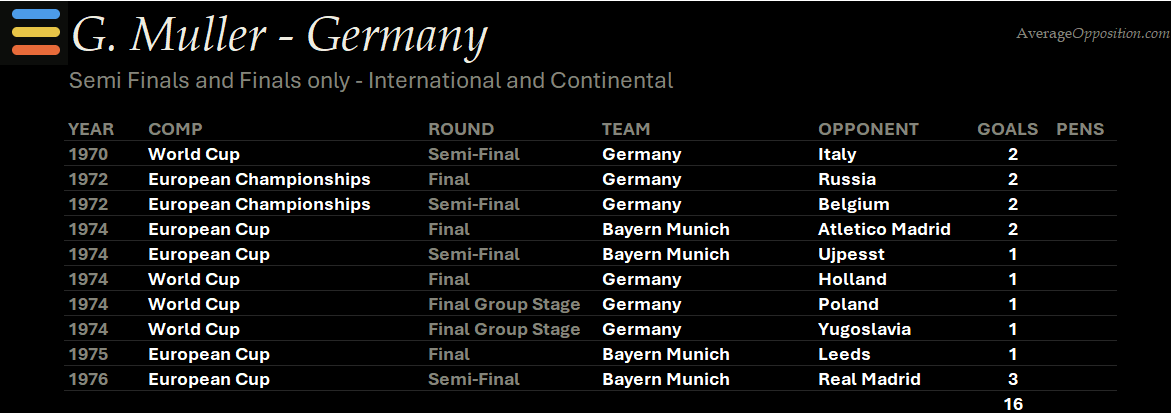
Gerd Müller. He is the only player with the Big Three collection. He has the World Cup final, the Euros final and the European Cup final. There’s no other player to have done it in Europe, and no one from South America that has the World Cup, Copa América and Libertadores hat trick. As no teams outside of Europe or South America have won the World Cup, it’s a unique achievement.
And just for good measure, he did it in the semi-final of each competition too. Should he appear higher in the GOAT debate? Absolutely, on goalscoring alone.
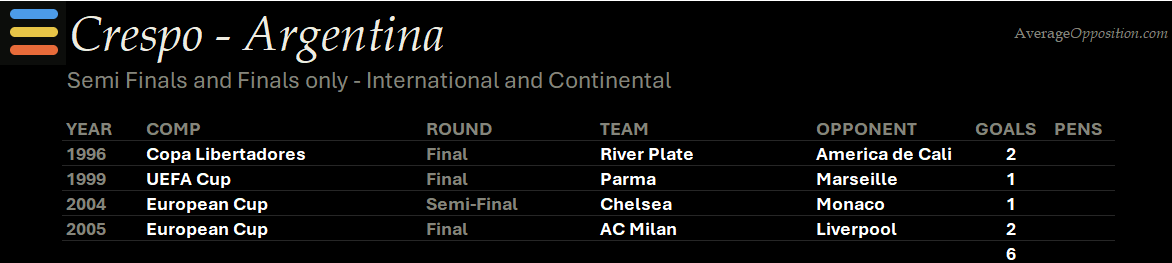
Hernán Crespo — be honest, you didn’t expect to see his name here, did you? But here he is, often overlooked due to being in the same vicinity as the more heralded Batistuta (Argentinian number 9, with cool long hair, and most famous for his time in Serie A). But is that fair? Based on scoring in big finals, no, it’s not.
Whilst Müller has the big three, Crespo has a unique three. His big-game prowess first appeared in the second leg of the Copa Libertadores final in 1996. His brace for River Plate overturned the first-leg 1–0 defeat, earning River just their second Libertadores trophy at the time. He left the same year for Italy, joining that legendary Parma team in the world’s strongest league. Proving his big-game performance was no fluke, he scored the opening goal against Marseille in the 1999 UEFA Cup final in a 3–0 victory.
And to make up the hat trick of big final goals, his brace against Liverpool in the 2005 Champions League final put AC Milan 3–0 up before half-time. The second goal was the epitome of cool under pressure, and one of the best finishes you’ll see (doing justice to the equally good Kaká assist). Unfortunately for him, it somehow wasn’t enough to lift the trophy. One of only two men to have scored in both the Copa Libertadores final and the European Cup final. Any guesses on the other?
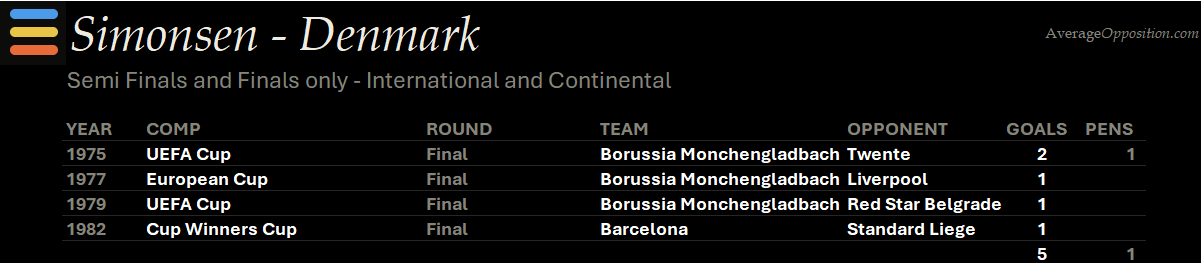
Allan Simonsen. An equally unexpected name, especially for those born after the 60s. Simonsen was a former Ballon d’Or winner (1977) who is the only player to have scored in each of the three UEFA finals. Back then it was the European Cup (now the Champions League), the UEFA Cup (now the Europa League), and the Cup Winners’ Cup (no longer running — the third UEFA tournament is now the Conference League).
Most in England will know him as the footballing superstar that joined second-tier Charlton Athletic whilst still only 30. It was a short stay, but saw 15 goals in 19 games. The final goals saw him pick up two UEFA Cup medals — scoring against both Red Star Belgrade and Twente — on top of the Cup Winners’ Cup medal with Barcelona in 1982. His European Cup final goal was an equaliser against eventual winners Liverpool, as the Merseyside club picked up their first title.
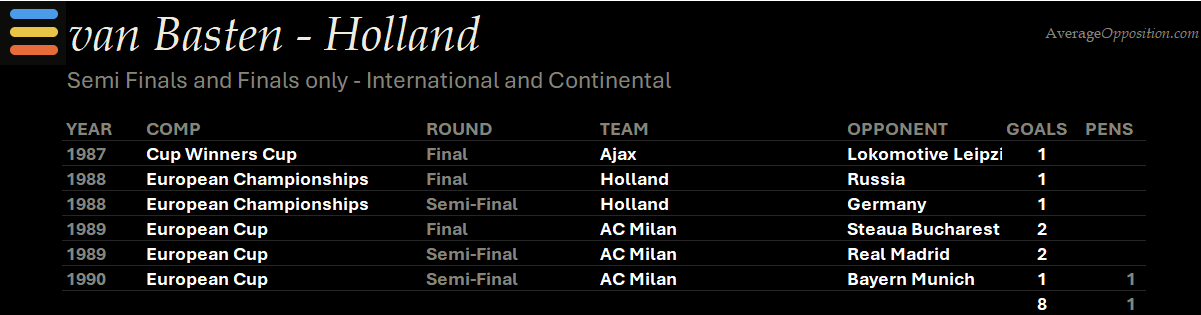
Marco van Basten. If R9 is considered a “what if?” player despite still achieving a lot after the injury, then van Basten is equally deserving of the question. Retired by 28, he still had time to score in the final of three big tournaments — and, like Crespo, managed it for three different teams.
The headline goal is the physics-defying volley against Russia in the final of Euro ’88 — somehow the Netherlands’ only international silverware (three World Cup finals, and three defeats). If you want to ensure his big-game credentials, then a Cup Winners’ Cup final goal for Ajax in 1987 is then bettered by his 1989 European Cup final goal for AC Milan against Steaua Bucharest. It was a good three years for van Basten, who was rewarded with three Ballon d’Or awards in total across his career.
Other noticeable feats
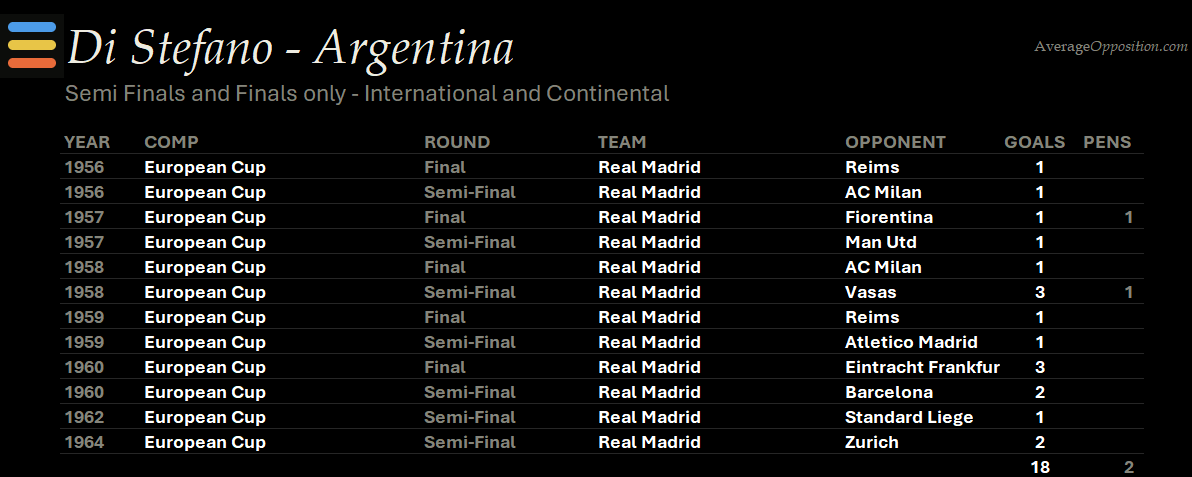
Alfredo Di Stéfano scored in five separate European Cup finals, in consecutive years from 1956 to 1960. Not just that, but the semi-final in each of those years, plus 1962 and 1964, just for the fun of it. He truly is the king of the European Cup. His seven goals in the finals are matched by his teammate Puskás, but Puskás did it in two years rather than five.
Scorer of the most combined semi and final goals
Cristiano Ronaldo — if Di Stéfano is the king of the European Cup, then Cristiano Ronaldo is the king of the Champions League rebrand. In the modern era of the Champions League format, and if we’re being fair, it’s harder to win given the quality of the teams in it (four or five teams from the strongest leagues now enter, as opposed to one), Cristiano Ronaldo is the only player to have scored in three separate finals. And he did so scoring for two different teams. He scored the opener in the 2008 win over Chelsea for Manchester United, before scoring a penalty in the 4–1 win over Atlético Madrid (2014), and then two against Juventus in 2017.
Chuck in 13 Champions League semi-final goals and he has 17 late-stage UCL goals.
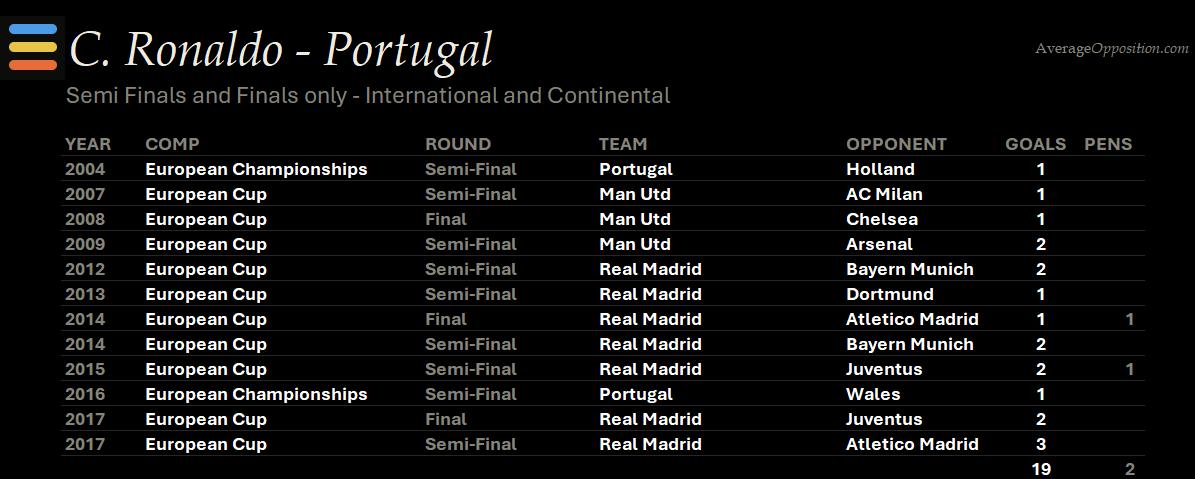
Whilst R9 is hit with the Champions League stick, so too is Cristiano Ronaldo with the international stick. Perhaps a little unfairly, given he scored in the semi-final of both Euro 2004 and Euro 2016.
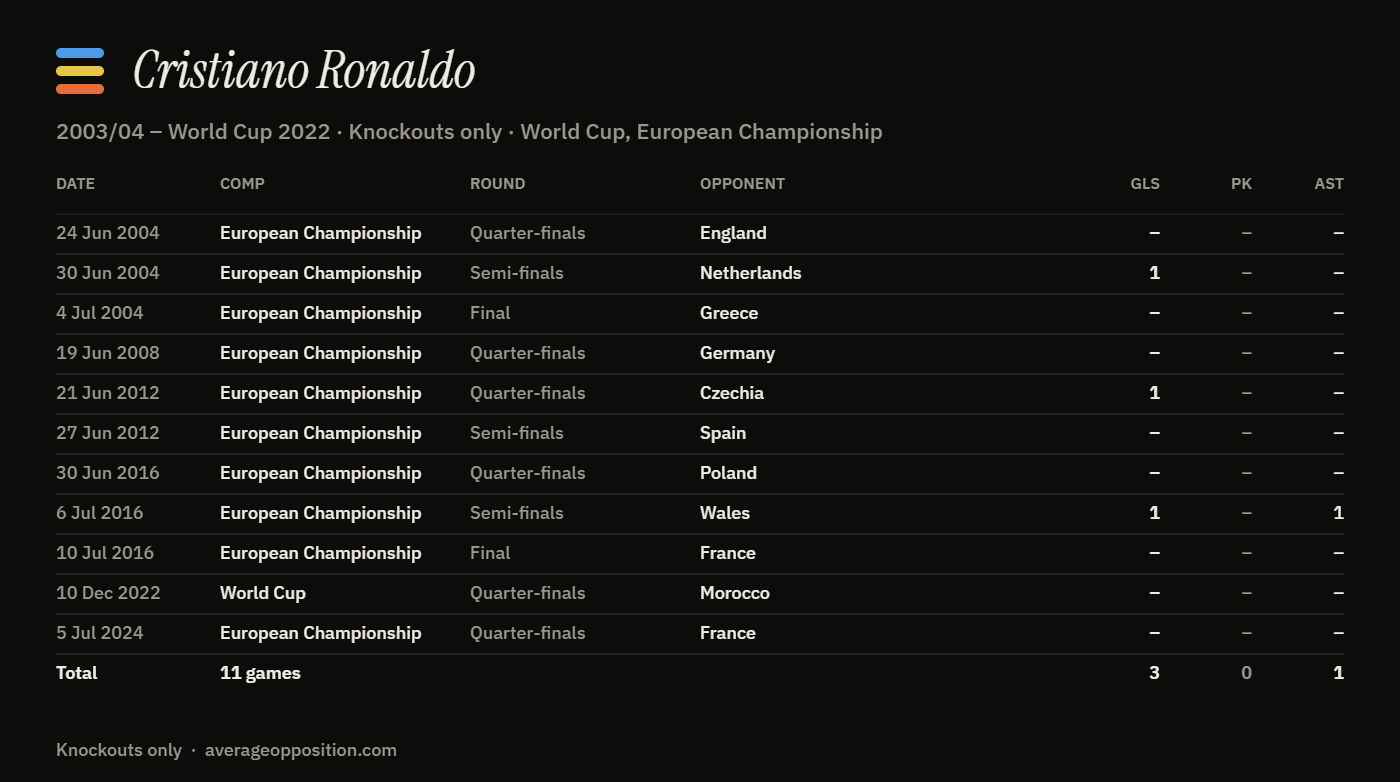
But given his legacy is going to be as the scorer of a thousand-plus goals, the lack of a big international moment in the biggest games will see him questioned by some. Either way, with 19 semi and final goals in the biggest competitions, he’s scored the most big-game goals in this list.
Scored in finals in three different decades
Pelé. Only five players in history have scored in two World Cup finals. Vavá was the first to achieve it in the back-to-back Brazil wins in 1958 and 1962. Pelé followed suit in 1970, and later on Zidane, Mbappé and Breitner all managed it. In short, it’s pretty hard to achieve. And Pelé also had a decent record in the Copa Libertadores for his beloved Santos — scoring three final goals and seven semi-final goals along the way. In fact, something that often gets overlooked is his hat trick against France in the semi-final, aged only 17. But that’s only because he then scored a brace in the final.
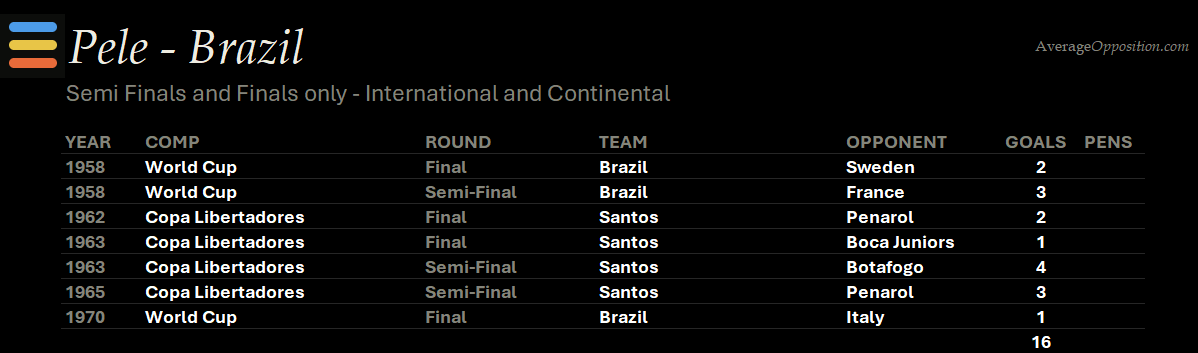
The goal in the 4–1 win over Italy in the 1970 final saw him become one of only two players in this list to have scored in finals in three different decades. There’s a reason he was known as the king of football.
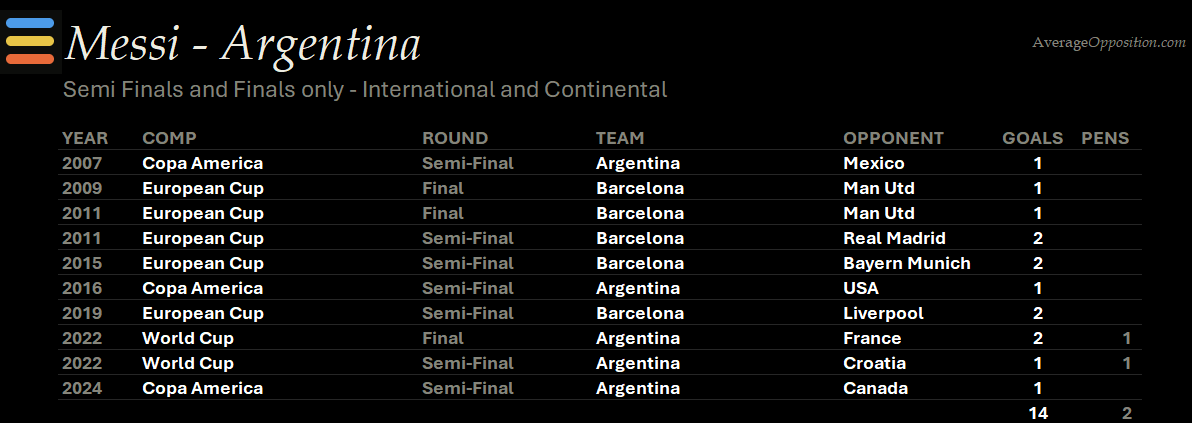
Lionel Messi — one of just a small club to have scored in both the World Cup final and the Champions League final (officially six, but realistically seven with Schiaffino), Messi has done it on the biggest stages in the 2000s, 2010s and 2020s. Thankfully for Argentina fans, he reversed his international retirement after years of final heartaches, and rolled back the years to lift the 2022 World Cup — after also notching in the 2009 and 2011 Champions League finals, both against Manchester United.
He has a decent number of semi-final goals as well, with a total of 14 goals on the biggest stages. That’s enough to put him in sixth place, after his mate Cristiano, Di Stéfano, Pelé, Müller and Puskás.
Other notable achievements
- Kurt Hamrin — scored in three different Cup Winners’ Cup finals (for Fiorentina and AC Milan).
- Alberto Spencer — scored eight Copa Libertadores final goals across 1960, 1961, 1962 and 1966. These finals were two-legged, and some years even had a third leg (a replay if level). Either way, he’s the Di Stéfano of South America. Yes, I’m aware Di Stéfano was from South America.
Scorers in both the World Cup final and the European Cup final
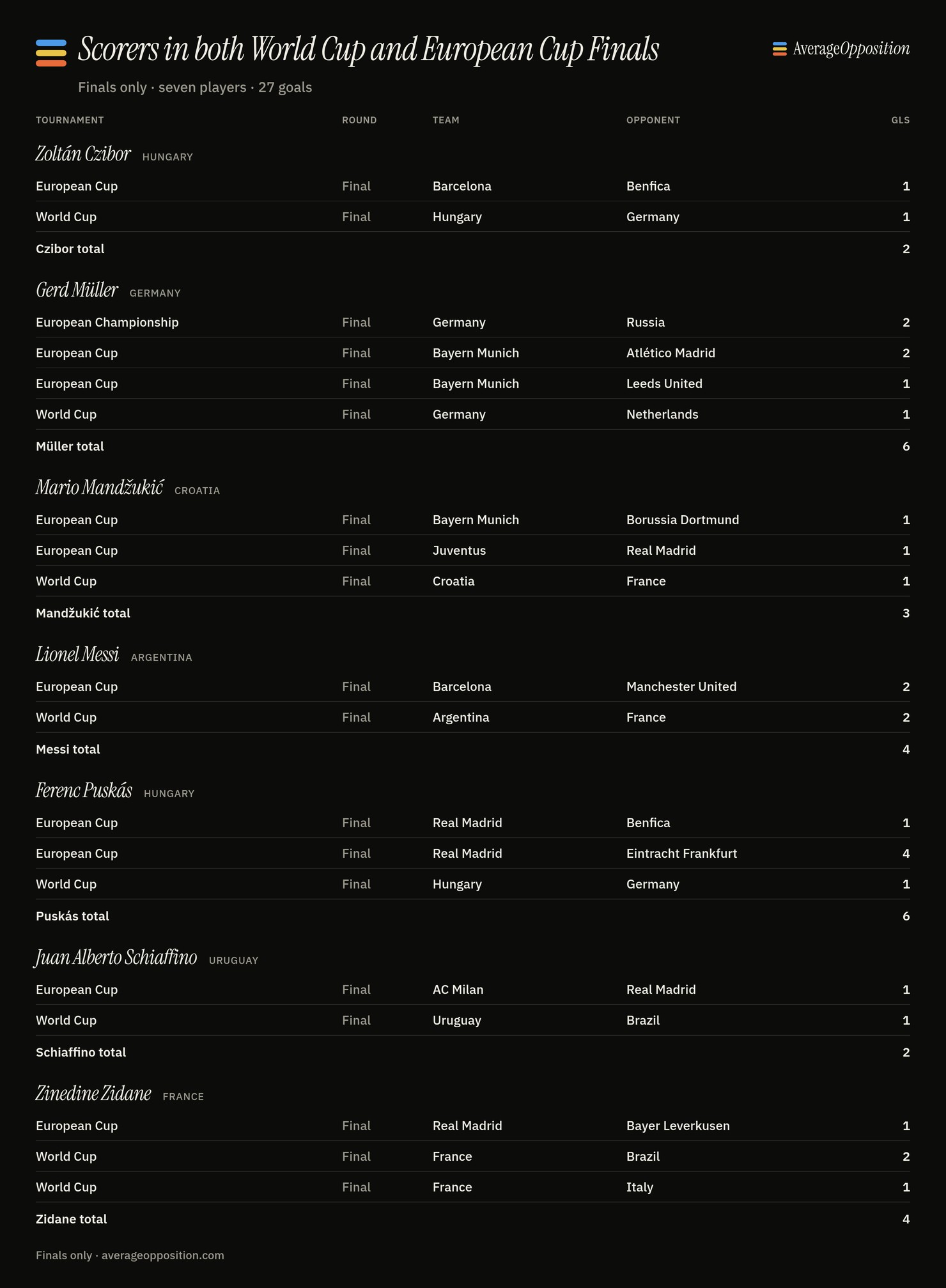
Schiaffino is often overlooked here. The 1950 World Cup didn’t have a final, but was to be decided by a final group stage. However, with Brazil and Uruguay in 1st and 2nd coming into the final game, it was essentially a final — with a slight twist. A draw would have been enough for Brazil. Uruguay had to win. Big-game mentality.
Besides him is Zidane, with an interesting record in the big games. He was never what you’d regard as prolific. In fact his best scoring season was 12, in 2001/02 and 2002/03. However, he stepped up in the biggest games, with three World Cup final goals (across two finals) and that left-foot volley to win the Champions League for Real Madrid in 2002.
Müller and Messi have been covered above, which leaves the Hungarian pair of Barcelona’s Czibor and Real Madrid’s Puskás. Czibor was good in the big games, but Puskás seemed to have nerves of steel — two European Cup final hat tricks (against Eintracht Frankfurt in 1960 and Benfica in 1962). Add to that a goal in the World Cup final of 1954 and various semi-final goals, and he’s on 15 for the biggest tournament semi-final and final goals. And for good measure, he scored two hat tricks against Barcelona in one season.
And lastly, Mario Mandžukić. Unless you can reel off the quiz-question answer, not many people think of him in terms of big-game impact. But his record is impressive. Like Cristiano Ronaldo, he scored for two different teams in Champions League finals (Bayern and Juventus). In the World Cup, he scored in the 2018 semi-final against England before notching against France in the final. Unfortunately for him, he also notched for France in the same final.
The list is shorter for those that scored in both the World Cup and Copa Libertadores final:
- Pelé
- Burruchaga
- Bertoni
Where is……
Maradona. As this is tracking just goals, he pops up with just three. That’s still three more than most, but for a prolific attacker (better than a one-in-two strike rate), you’d expect him to have more. This, of course, doesn’t pick up his assist for Burruchaga’s winner in 1986.
He has the brace against Belgium in the 1986 World Cup semi-final (plus two standard goals in the quarters against England), then a penalty in the 1989 UEFA Cup final for Napoli.

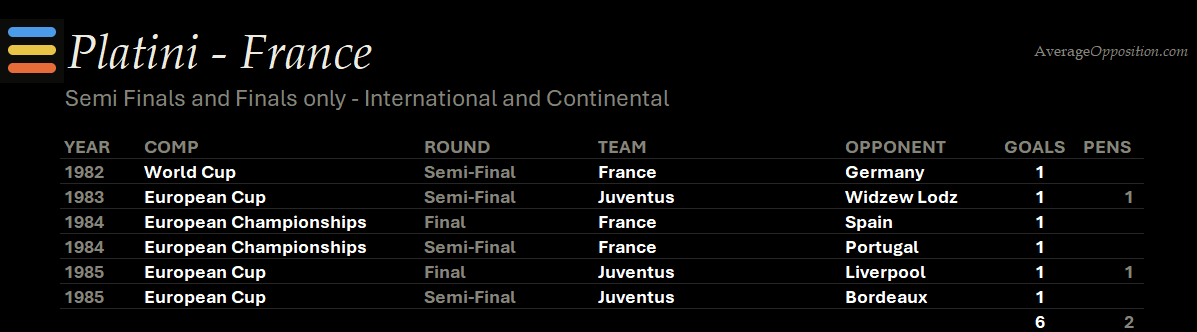
There’s an interesting comparison between him and Michel Platini — same position, overlapping eras, and a near identical scoring rate at club level:
- Platini — 582 games, 313 goals
- Maradona — 589 games, 311 goals
Yet Platini did it more on the bigger stage, in terms of goals at least. You could argue that his impact in the 1984 Euros was as big as Maradona’s in the 1986 World Cup. On top of a goal in the final against Spain, he also scored in the European Cup final in 1985 against Liverpool.
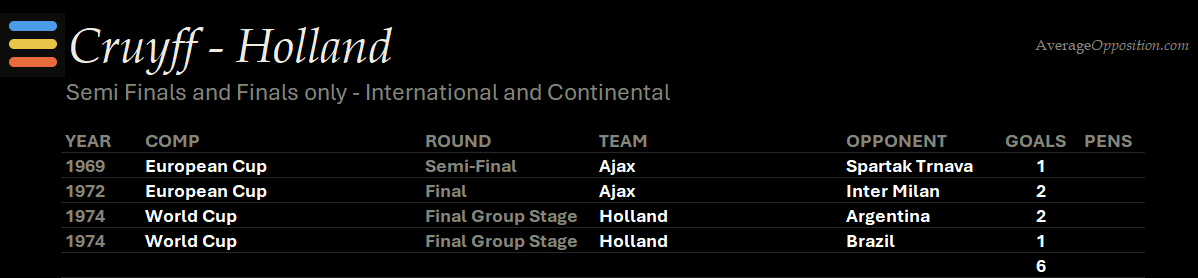
Cruyff — a decent showing from arguably the most transformative man in modern football, with the highlight being a brace in the 1972 European Cup final as Ajax won their second of three straight titles, in a run that followed Feyenoord’s win in 1970.
He lit up the 1974 World Cup, where there were no semi-finals, but instead a final group stage.
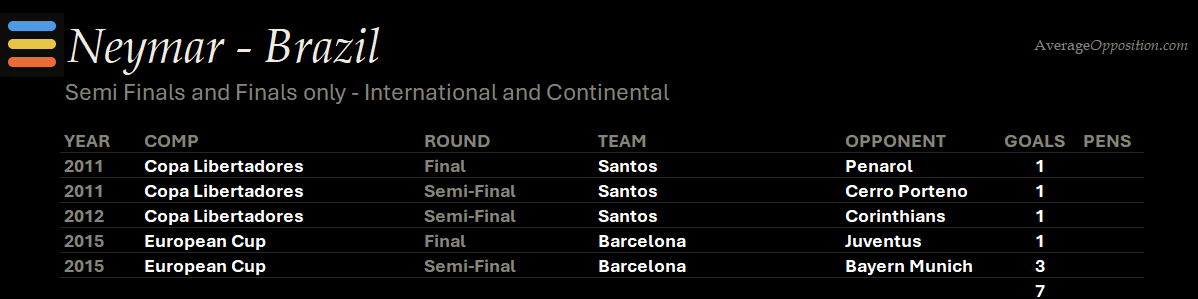
Neymar. He’s there alright, along with Crespo as the other player to have scored in both the Libertadores and Champions League finals, on top of a handful of semi-final goals for good measure. The fact that he’s still playing 11 years later but doesn’t feature past 2015 could point to some bad career choices and a hint of talent wasted, but let’s focus on the positives. He was excellent in the World Cup for Brazil before injury cost him a place in the semi-final.
Mbappé — four goals in World Cup finals is enough to put him clear at the top. He is ahead of Geoff Hurst, Vavá, Pelé and Zidane (all on three), albeit two of the goals were penalties. Surprisingly he’s not had that big impact in the latter stages of the Champions League, despite playing for PSG and Madrid for a number of years. In fact his only late-stage goal is for Monaco in the 2017 semi-final against Juventus.
Yamal — despite still being a teenager at the time of writing (November 2026), he already has a goal in the semi-final of Euro 2024, on top of a goal at the same stage of the 2024/25 Champions League in an entertaining tie against Inter Milan. You would expect he’ll feature pretty highly in another 10 to 15 years.
What else?
It’s hard to know when to stop, as there’s so many more stories and players to talk about. Look at Ángel Di María, the only other player to have scored in the World Cup and Copa América final aside from Ronaldo Nazário. Gabriel “Gabigol” Barbosa scored in three Libertadores finals in four seasons.
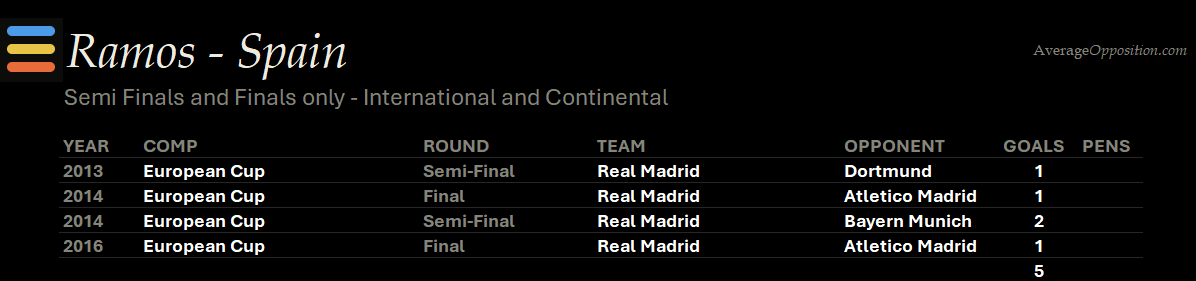
Paul Breitner, Allofs, Roth, Alenichev, Adriano all have multiple final goals. In Africa, Egypt’s Aboutrika has goals in both the AFCON and CAF Champions League finals. And Saudi Arabia’s Noor has scored in three separate Asian Champions League final games for Al-Ittihad. But there’s one last player I think deserves highlighting for popping up in the big games, despite being a centre-back. Sergio Ramos, also known as the scourge of Atlético Madrid, has managed five goals in the semis and finals of the Champions League. None of which were penalties. If you add in clean sheets in the finals of the World Cup and the Euros for his country, you have the man that should probably be captain in any big game (if you take out a slightly iffy disciplinary record). Bravo.
Who’s missing?
There are three big names that are surprising by their lack of goals, when you consider that they’re multi-time golden boot winners and have played in the big games.
Haaland, Tevez, and Henry. Zlatan also, but he only has two appearances in big semis and finals, so we’ll let him off. Go onto the normal site and look at their Other Big Games pages.

Are all goals weighted evenly?
Absolutely not, but I’m not falling for the same trap as the 2012 edition, where I attempted to give a score to each (a World Cup final five points, a semi-final four points, and so on) and faced a lot of angry football fans.
For a start, you can never please everyone all the time. Some will argue that the Copa Libertadores final should be worth the same as the European Cup final. I’d then point to many two-legged ties (and sometimes a third game as a replay).
The World Cup didn’t have a semi-final or a final in 1950, so are all the final group-stage games worth the same? No. The last game decided the world champions, and with it came different pressures. The earlier tournaments had fewer teams (the Euros especially).
Today’s European Cup / Champions League is harder to win, as you have four or five strong teams from the strongest leagues you have to beat. The UEFA Cup and Cup Winners’ Cup were stronger competitions in days past than the Europa League and Conference League now.
Cristiano Ronaldo’s Champions League final goals also tell a different story. The one for Manchester United against Chelsea was the opener in a 1–1 draw. The goal against Atlético Madrid was a penalty to make it 4–1 with just minutes left to play. So there’s different levels of pressure in big games.
Anyway, you get the point. Either way, these are all big games, and come with big-game pressure. The level of opponents differs as well, so I’ll leave you to decide what goals are worth more than others.
Can’t see a name you’re looking for? Use the search bar to see if they notched in a big semi or final: Big Game Scorers.
Cheers, Liam