Originally published 17 July 2012. Tables rebuilt from the old Excel screenshots into this site’s format. Photos from the original post.
Next up in the comparison series is a pair of teams rather than players. Both Arsenal in 2003-04 and more recently Juventus last season, managed the ultimate achievement — going the whole league season unbeaten. There’s no winner or loser in this comparison, more an appreciation of two of the great club teams of the modern era….
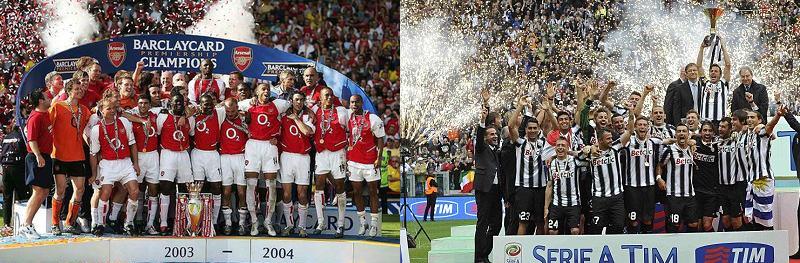
My Mum used to say that there’s more than one way to skin a cat. It’s fair to say she’s more of a dog person, but that same sentiment is also applicable when comparing Arsenal’s Invincibles of 2003-04 with Juventus’s class of 2011-12 (I’m not sure if they have a nick name yet?). Both teams performed the remarkable by going the league season undefeated, but they did it in different ways. On the surface, their league records are pretty similar —
League table
| P | W | D | L | GF | GA | GD | Pts | |
|---|---|---|---|---|---|---|---|---|
| Arsenal 2003-04 | 38 | 26 | 12 | 0 | 73 | 26 | 47 | 90 |
| Juventus 2011-12 | 38 | 23 | 15 | 0 | 68 | 20 | 48 | 84 |
Arsenal had the most points — largely due to Juventus’ love for a draw in the first half of the season — but the goal differences are near identical. I’ll admit that I expected Arsenal to have a far superior ‘goals for’ column, and likewise for Juve on the ‘goals against’. Looking at the goals involved, it backs up the oft used phrase, that a title winning team is built from the back. For all of Henry’s va-va-voom, the team kept 15 clean sheets on the way to letting in only 0.68 goals per game.
Starting point
Arsenal came into the season from a pretty strong starting point. Champions in two of the previous six seasons, theirs was a well established and particularly strong squad. Arsene Wenger had been in charge since the 1996-97 season and had never finished below 3rd place. They were strong contenders after finishing the previous season in second place to rivals Manchester United (and actually had a superior goal difference). In terms of changes, David Seaman’s retirement saw Jens Lehmann join from Borussia Dortmund, whilst Oleg Luzhny left the defence with a very young Gael Clichy coming in as back up to Ashley Cole. Jose Antonio Reyes later joined in January from Seville. Other than that, it was the squad that ended the previous season.
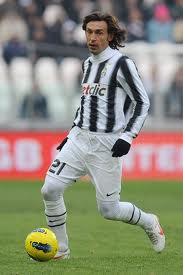
Juventus on the other hand were starting from quite a different spot. As is well documented, Juve had last “won” the league title in the 2005-06 season. That was immediately followed with relegation after the match fixing Calciopoli scandal. Although they achieved an immediate return to Serie A, the landscape had changed. Star players Vieira, Thuram, Ibrahimovic and Cannavaro all left the club, and in their absence, Inter had become the dominant team in the league — winning four successive titles from 2006-07 to 2009-10. Juventus finished 7th in both the 2009-10 and 2010-11 seasons as they struggled to return to former glories. After spells in charge by Deschamps, Ranieri, Ferrara, Zaccheroni and Delneri, they appointed yet another new manager for the start of 2011-12, with former right winger Antonio Conte taking over the hotseat. Their highest attendance was a lowly 25,000. The club was not in good health. But there were reasons for optimism. They moved into a new stadium, and made some shrewd signings in the summer, most notably Andrea Pirlo who was deemed surplus to requirements at champions AC Milan. Joining him was Roma’s Mirko Vucinic, Chile International Arturo Vidal and Lazio’s attacking full back Stephan Lichtsteiner. Winning the title was not expected, let alone going the league season unbeaten.
Squads
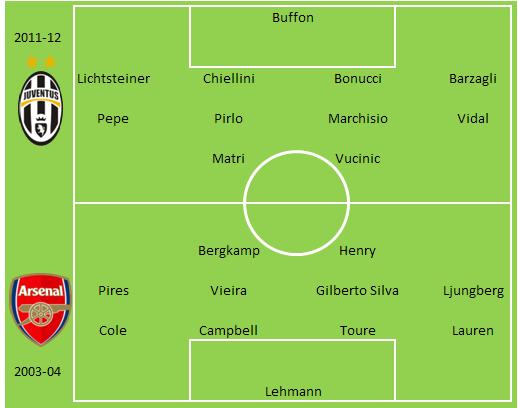
Juventus used 25 different players to Arsenal’s 22, with Juve players making 533 appearances between them, compared to Arsenal’s 499. Wenger relied very much on his First Choice eleven, whilst Juventus’ achievement has seen contributions from all around the squad. There was also a difference in the reliance of home grown players. Arsenal used just six British players in the league season — Sol Campbell and Ashley Cole were the only regulars though, whilst Juventus used a massive 18 Italian players, with Vucinic (Montenegro), Vidal (Chile) and Lichtsteiner (Switzerland), the only non-Italian regulars in the team.
In terms of experience and quality, Arsenal’s first XI was surely the better team on paper. Henry was arguably the World’s greatest striker at the time — he finished second to Zidane in 2003 and behind only Ronaldinho in 2004 in the FIFA World Player of the Year awards. Juve on the other hand will be looked back on as a team of great players, but before the season started, there weren’t many that would have broken into the Arsenal team. Buffon and Pirlo were World Champions with Italy, whilst Chiellini would have a case to be in over Toure.
Goalscoring stats
The first thing that catches the eye is the length of each team’s list. Arsenal have 13 different scorers including own goals (who got a decent four goals), compared to Juve’s incredible 21 different scorers. In my reviews of the Premier League, Serie A, Eredivisie, Bundesliga and La Liga this year, that’s the highest number of scorers for any team in those five leagues. Impressive stuff. But they needed it too, based on the total goals of their top scorer — just 10 for Matri.
Arsenal scorers 2003-04
| Gls | Top 6 | Middle | Bottom 6 | AOI | Pts | Pts (inc.) | |
|---|---|---|---|---|---|---|---|
| Thierry Henry | 30 | 10 | 13 | 7 | 11.93 | 20 | 23 |
| Robert Pires | 14 | 3 | 8 | 3 | 11.07 | 11 | 14 |
| Dennis Bergkamp | 4 | 0 | 2 | 2 | 13.75 | 4 | 5 |
| Freddie Ljungberg | 4 | 1 | 2 | 1 | 11.00 | 4 | 4 |
| Kolo Toure | 3 | 1 | 1 | 1 | 11.33 | 3 | 3 |
| Patrick Vieira | 3 | 2 | 0 | 1 | 8.00 | 3 | 5 |
| Edu | 2 | 2 | 0 | 0 | 2.00 | 2 | 4 |
| Sylvain Wiltord | 2 | 0 | 1 | 1 | 13.50 | 2 | 2 |
| Jose Antonio Reyes | 2 | 0 | 1 | 1 | 13.50 | 2 | 2 |
| Own goals | 4 | 1 | 3 | 0 | 8.75 | 4 | 4 |
| Jeremie Aliadiere | 1 | 0 | 1 | 0 | 8.00 | 1 | 1 |
| Ashley Cole | 1 | 0 | 0 | 1 | 16.00 | 1 | 1 |
| Lauren | 1 | 0 | 0 | 1 | 16.00 | 1 | 1 |
| Total | 73 | 20 | 32 | 21 | 11.05 | 57 | 67 |
Unsurprisingly, it was Henry that dominated scoring for Arsenal. The Frenchman did it against almost every opponent he faced, with just Spurs (14th), Birmingham (10th) and Bolton (8th) managing to keep him off the score sheet. His 10 goals against the teams in 2nd to 6th showed that he was a big game player in the league. Robert Pires was the other stand out performer, hitting 14 goals from out wide. Considering all of the attacking talent they had that season, it’s surprising that Henry and Pires contributed 60% of Arsenal’s goals that season.
By comparison, Juventus’ top two scorers combined to contribute 28% of the total team goals:
Juventus scorers 2011-12
| Gls | Top 6 | Middle | Bottom 6 | AOI | Pts | Pts (inc.) | |
|---|---|---|---|---|---|---|---|
| Alessandro Matri | 10 | 4 | 4 | 2 | 9.30 | 8 | 8 |
| Claudio Marchisio | 9 | 3 | 3 | 3 | 10.11 | 8 | 6 |
| Mirko Vucinic | 7 | 1 | 3 | 3 | 11.00 | 6 | 5 |
| Arturo Vidal | 7 | 2 | 4 | 1 | 10.14 | 6 | 7 |
| Alessandro Del Piero | 6 | 1 | 2 | 3 | 11.67 | 6 | 4 |
| Simone Pepe | 5 | 0 | 2 | 3 | 13.60 | 5 | 4 |
| Fabio Quagliarella | 4 | 1 | 1 | 2 | 12.75 | 4 | 3 |
| Andrea Pirlo | 3 | 1 | 1 | 1 | 10.67 | 3 | 3 |
| Giorgio Chiellini | 2 | 0 | 2 | 0 | 11.00 | 2 | 2 |
| Marcelo Estigarribia | 2 | 0 | 2 | 0 | 9.00 | 2 | 2 |
| Stephan Lichtsteiner | 2 | 0 | 2 | 0 | 8.50 | 2 | 2 |
| Leonardo Bonucci | 2 | 1 | 1 | 0 | 7.00 | 2 | 3 |
| Marco Borriello | 2 | 1 | 0 | 1 | 10.50 | 2 | 2 |
| Own goals | 2 | 1 | 1 | 0 | 5.50 | 2 | 2 |
| Emanuele Giaccherini | 1 | 1 | 0 | 0 | 3.00 | 1 | 3 |
| Andrea Barzagli | 1 | 1 | 0 | 0 | 6.00 | 1 | 2 |
| Luca Marrone | 1 | 0 | 1 | 0 | 11.00 | 1 | 2 |
| Michele Pazienza | 1 | 0 | 1 | 0 | 8.00 | 1 | 1 |
| Total | 68 | 18 | 30 | 20 | 10.53 | 58 | 51 |
Matri was the only player to reach double figures with a lowly ten goals, which is pretty rare in a title winning team. Although he only scored ten in total, four of them came against the other Top 6 opponents — most importantly in the game vs AC Milan to secure a 1-1 draw in the 83rd minute. Aside from Matri, Marchisio added an impressive 9 goals from midfield, three against each range of opponent.
In terms of the importance of their goals as points, it’s two familiar faces again that dominate:
Points from goals (5+ pts)
| Gls | Pts | Pts (inc.) | Pts / gl | Pts / gl (inc.) | |
|---|---|---|---|---|---|
| Thierry Henry | 30 | 20 | 23 | 0.67 | 0.77 |
| Robert Pires | 14 | 11 | 14 | 0.79 | 1.00 |
| Patrick Vieira | 3 | 3 | 5 | 1.00 | 1.67 |
| Alessandro Matri | 10 | 8 | 8 | 0.80 | 0.80 |
| Claudio Marchisio | 9 | 8 | 6 | 0.89 | 0.67 |
| Arturo Vidal | 7 | 6 | 7 | 0.86 | 1.00 |
| Mirko Vucinic | 7 | 6 | 5 | 0.86 | 0.71 |
| Alessandro Del Piero | 6 | 6 | 4 | 1.00 | 0.67 |
Henry’s goals were worth a whopping 23 points, or 26% of Arsenal’s total, whilst Pires follows suit with a very decent point per goal for his 14 strikes. Patrick Vieira was the most efficient with his goals, collecting five points from his three hits. Juventus once again have more of a spread across the team.
Team stats
Juventus trumped Arsenal in the clean sheets measurement, as if to live up to the Italian stereotype, with 21 to Arsenal’s 15, and carrying on that trend, they had the lower number of goals conceded with just 20 to Arsenal’s 26 — both fantastic records. Arsenal’s 26 in particular deserves praise. Keown started just 3 games, whilst Dixon, Winterburn, Adams and Bould were long gone. Same Top 6 / Middle / Bottom 6 idea as the rest of AverageOpposition.
Clean sheets / results / goals conceded
| CS | T6 | Mid | B6 | W | D | L | GA | GA/G | |
|---|---|---|---|---|---|---|---|---|---|
| Arsenal | 15 | 5 | 6 | 4 | 26 | 12 | 0 | 26 | 0.68 |
| Juventus | 21 | 4 | 8 | 9 | 23 | 15 | 0 | 20 | 0.53 |
Vs opponent range — GA/G and failed to score
| T6 GA/G | Mid GA/G | B6 GA/G | Failed | T6 fail | Mid fail | B6 fail | |
|---|---|---|---|---|---|---|---|
| Arsenal | 0.40 | 0.63 | 1.00 | 7 | 2 | 2 | 3 |
| Juventus | 0.30 | 0.69 | 0.50 | 10 | 3 | 4 | 3 |
Both teams kept a decent number of clean sheets against Top 6 rivals, whilst both conceded less than a goal a game against the Top teams. Juventus made up the extra clean sheets against the Bottom 6 teams, with Arsenal keeping a surprisingly low four clean sheets in the twelve games against them. They kept as many against Top 6 teams in just 10 games. Big game defenders? Yep.
Moving on to the goals scored, it’s the North London team that lead the way here. But not by much. Either way, both teams hitting 18 goals in the 10 games they played against the teams in 2nd to 6th. That’s a goal difference of plus 15 for the Italians and 14 for Arsenal in the Top 6 mini leagues. In fact when looking at the points taken from the Top 6, both teams took 24 points from 30 available — giving up just three points to their rivals.
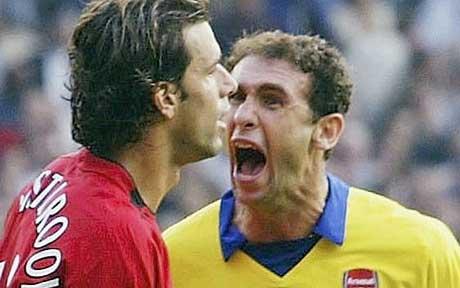
The closest Arsenal came to defeat was in the 0-0 at Old Trafford when Ruud van Nistelrooy missed a very late penalty, and Martin Keown turned into the incredible hulk.
Juventus also narrowly missed defeat against title rivals. In the 1-1 draw at AC Milan, Matri’s equaliser was in the 83rd minute, but that only tells half the story, as there was widespread outrage when AC Milan had a seemingly good goal disallowed that would have put them 2-0 up. However good the teams may be, you’ll need a bit of luck to go a whole season unbeaten.
Apart from the league — Europe and cups
Juventus had the added help of no European campaign which definitely helped them in the league, but it also helped them in the Coppa Italia as well — going unbeaten in that until the final, where they lost to Napoli in Del Piero’s last game for the club. They were 90 minutes from going the whole season undefeated in all competitions. The bottlers…..(just kidding).
Arsenal domestically put up a pretty good fight. Aside from the league, they got to the Semi Finals of both the FA Cup and the League Cup. In Europe, they had a mixed performance. Outclassed by Inter Milan 3-0 at home, they then went on to draw 0-0 away at Lokomotiv Moscow, before another defeat away at Dynamo Kiev. They won each of the return fixtures though, including a stunning 5-1 win in the San Siro. In the last 16, they beat Celta Vigo 5-2 on aggregate before being paired with Chelsea in the Quarters. After a 1-1 draw at Stamford Bridge, Arsenal took a 1-0 lead through Reyes by half time and looked in control. Unfortunately for them, Frank Lampard and then footballer Wayne Bridge (in the 87th minute) turned the tie on it’s head. That season will always be looked on as a missed chance for Arsenal, who would have faced Monaco in the Semi Finals and Porto in the Final.
Strength of the league
Using European performance to judge the standard of the league, England only had one Quarter Finalist in 2002-03 (Man United), and two quarter finalists and one Semi Finalist in 2003-04. Italian teams in 2010-11 had one quarter finalist (Inter), whilst the 2011-12 season saw the same, with AC Milan reaching the quarters before bowing out to Barcelona. There’s a case to be argued that the strength of the league opposition wasn’t as hard as in previous years. It’s not a perfect measurement, but I’m nothing if not thorough.
Precedent
Serie A has seen two teams go a league season unbeaten previously — Perugia in 1978-79 (though didn’t win the league), and AC Milan in 1991-92. However, they were both 34 game seasons — with Juventus being the first to do it in a full 38 game season. In England, the term Invincibles was initially used for Preston North End in 1888-89 over a 22 game season. Once again, Arsenal are the first team to do it in 38 games. It’s an incredible achievement and judging by the history, it’s near impossible to do, so hats off to them.
After
For Juventus, they certainly can’t be accused of resting on their laurels. At the time of writing (just 2 months after the season ended — finger, pulse etc), the Turin giants have signed promising youngster Pogba from Man Utd, Brazilian legend Lucio from rivals Inter Milan, re-signed Italy international Sebastian Giovinco and are currently sniffing round Robin van Persie.
Why would van Persie consider leaving Arsenal for Juventus? Well unfortunately for Arsenal fans, and indeed many neutrals, that 2003-04 team was the last to win the title for Arsenal. The team was eventually broken up with captain Vieira leaving the following year after scoring the winning penalty in the 2005 FA Cup final (their last trophy). Despite a Champions League final appearance in 2006, it’s fair to say the team has struggled since 2003-04. Every year since 2005 has seen an established member of the squad leave. Summer signings of Giroud and Podolski are at least a signal of intent, but it’s a far cry from the Invincible team.
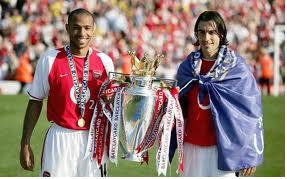
So there you have it, that’s how two teams defied all of the odds. Whilst both teams relied heavily on a solid defensive basis, Arsenal often looked to Henry and Pires to provide a spark going forward, and Juve shared the goalscoring responsibilities across the squad. What they did have in common was a steely desire to win, a great quality on the ball, and domination against their rivals.
Arsenal of 2003-04 and Juve of 2011-12 embraced a bit of luck along the way, but both will go down in the history of football as legendary teams. The stats can only tell half the story of two great teams.
Cheers,
Liam
Next idea: Contact.